


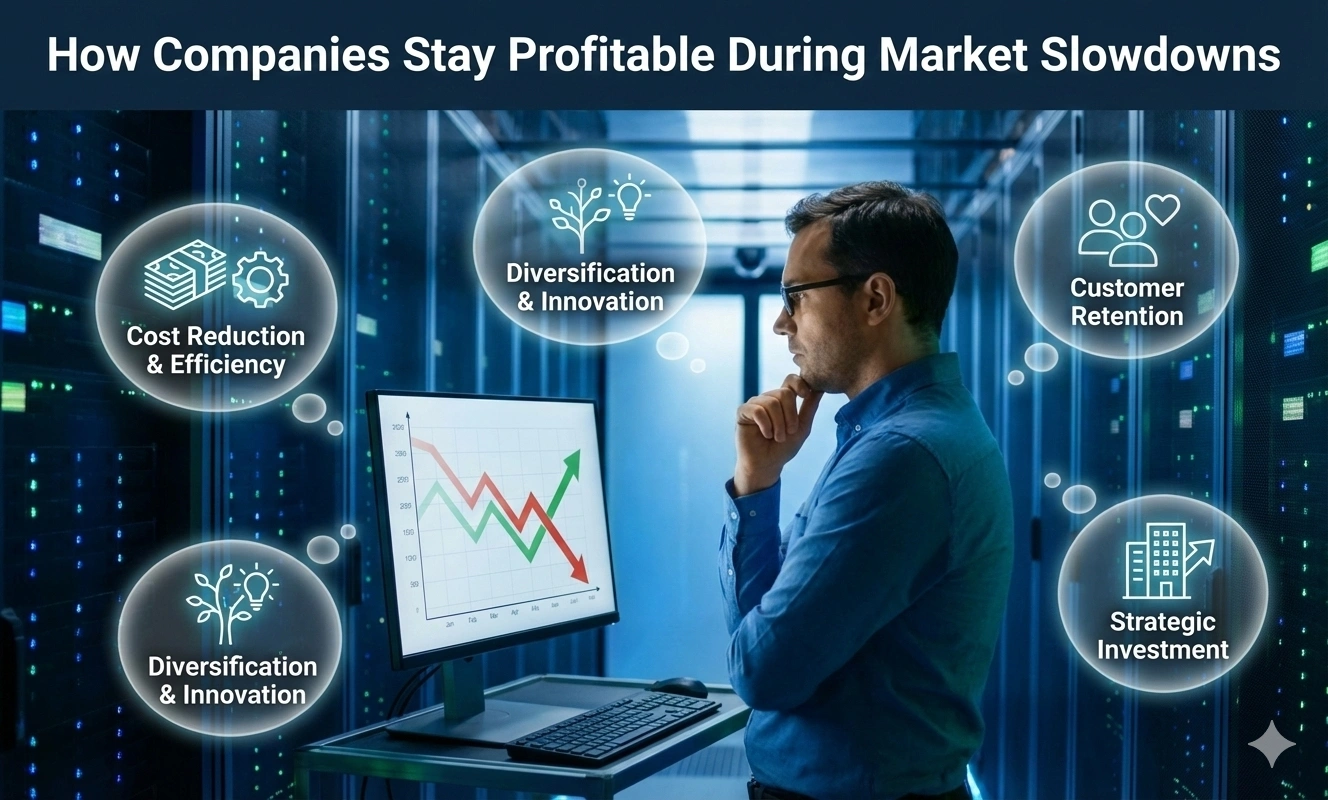
Every business, no matter how successful, eventually faces a slow market. Demand weakens, customers delay decisions, costs rise, and uncertainty becomes part of daily operations. These periods test leadership more than times of rapid growth.
Some companies struggle badly during slowdowns. Others remain stable, protect profits, and even come out stronger. The difference is not luck. It is preparation, discipline, and smart decision making.
This article explains how companies stay profitable during market slowdowns. It focuses on real world strategies that businesses actually use. These ideas are practical, easy to understand, and relevant across industries and company sizes.
What a Market Slowdown Really Means for Businesses?
A market slowdown does not always mean a crisis or collapse. In many cases, it simply means customers become cautious and spending slows down.
During slowdowns, businesses often experience lower demand for products or services, longer sales cycles, increased pressure on prices, rising operational costs, and uncertainty in planning and forecasting.
Companies that remain profitable understand that slowdowns are temporary, but decisions made during them have long term impact. Leaders who treat slow periods as strategic phases rather than emergencies tend to perform better.
Why Preparation Matters More Than Reaction?
Companies that survive slow markets usually prepared long before trouble appeared.
1. Building Financial Strength During Good Times
Strong businesses use profitable periods to build safety buffers. They maintain cash reserves, keep debt under control, avoid unnecessary fixed costs, and monitor margins closely.
When slowdowns arrive, these companies have time and flexibility to respond calmly instead of reacting out of fear.
2. Knowing What Really Drives Profit
Profitable companies understand their business deeply. They know which products or services generate the most profit, which customers are truly valuable, and which costs are essential.
This clarity allows leaders to cut distractions and protect what matters most.
Shifting Focus From Growth to Profitability
During strong markets, growth often becomes the main goal. During slowdowns, profitability becomes the priority.
1. Protecting Margins Instead of Chasing Volume
Companies that stay profitable focus on quality revenue, not just more sales. They reduce excessive discounting, prioritize higher margin offerings, and walk away from deals that do not make financial sense.
Strong margins protect the business even when sales volumes decline.
2. Letting Go of Low Value Activities
Market slowdowns force honest evaluation. Successful companies stop selling products with poor margins, exit partnerships that do not add value, and pause projects with unclear returns.
Simplifying operations often leads to better financial performance and clearer direction.
Controlling Costs Without Damaging the Business
Cost control is necessary, but it must be done carefully.
1. Smart Cost Optimization
Instead of cutting everything, profitable companies focus on efficiency. They review operational processes, vendor agreements, administrative expenses, and technology usage.
The goal is to remove waste, not weaken the company.
2. Protecting Key Talent and Capabilities
People are critical to long term success. Companies that stay profitable try to retain high performers, avoid unnecessary layoffs, and improve productivity through better systems.
Strong teams help businesses recover faster when markets improve.
The Role of Strong Cash Flow Management During Slowdowns
Cash flow becomes the lifeline of any business when markets slow down. Even profitable companies can struggle if cash is poorly managed. Businesses that stay profitable track cash movement daily, not occasionally.
They tighten payment cycles, follow up on receivables, and sometimes offer incentives for early payments. On the expense side, they delay non essential spending, renegotiate vendor terms, and prioritize expenses that directly support revenue.
Clear visibility into cash flow allows leaders to make confident decisions without panic.
Strengthening Supply Chain and Vendor Relationships
Slow markets often expose supply chain weaknesses. Companies that remain profitable treat suppliers as partners rather than just cost centers.
They maintain open communication, explore flexible payment arrangements, and plan demand together. Strong vendor relationships often lead to better pricing, consistent supply, and mutual support.
Diversifying suppliers also reduces risk and protects operations from disruption.
Strengthening Customer Relationships During Slow Markets
Customers become more selective during uncertain times.
1. Focusing on Existing Customers
Existing customers provide stability when new sales slow down. Profitable companies invest more in customer support, proactive communication, and value delivery.
Retention becomes more important than acquisition during slow periods.
2. Selling Value Instead of Lower Prices
Rather than competing only on price, successful companies highlight reliability, long term benefits, and overall cost efficiency.
This approach protects brand trust and prevents long term margin damage.
Adapting Products and Services to Market Conditions
Customer needs often change during slowdowns.
1. Making Offerings More Flexible
Companies adjust offerings to match customer budgets. This may include smaller packages, flexible payment options, or scalable service plans.
These changes help retain customers without reducing quality.
2. Improving What Already Exists
Innovation does not stop during slow markets. Smart companies refine existing products, simplify features, and improve performance.
Small improvements can strengthen customer loyalty and efficiency.
Using Data to Guide Decisions
Data becomes especially important when uncertainty is high.
1. Tracking the Most Important Metrics
Profitable companies focus on cash flow, margins, customer retention, and operating costs. These metrics provide clarity and direction.
2. Planning for Multiple Scenarios
Instead of relying on one forecast, strong leaders prepare for different outcomes. This allows quick responses without panic and builds organizational confidence.
Leadership Communication During Uncertain Times
Clear communication is essential during slowdowns.
1. Keeping Teams Informed and Aligned
Successful leaders share realistic updates, explain priorities, and set clear short term goals. Transparency reduces fear and confusion.
2. Encouraging Responsibility Across Teams
Leaders encourage teams to identify cost savings, improve processes, and support customers better. Shared responsibility strengthens execution.
Adjusting Marketing Strategies Without Overspending
Many companies cut marketing aggressively during slowdowns. Profitable companies shift strategy instead of stopping entirely.
They focus on high impact, low cost channels such as content marketing, email, organic social media, and SEO. Messaging emphasizes trust, reliability, and long term value rather than aggressive selling.
This keeps the brand visible without overspending.
Using Technology to Improve Efficiency
Technology helps companies do more with less.
a) Automating Repetitive Work
Automation reduces costs and errors in billing, reporting, inventory tracking, and customer support.
b) Improving Visibility and Control
Digital tools provide real time insights, faster decision making, and stronger operational control.
Building a Culture of Efficiency and Accountability
Companies that perform well during slowdowns often have strong internal cultures. Employees understand how their actions affect profitability.
Leaders encourage teams to challenge old processes, suggest improvements, and eliminate unnecessary steps. Small efficiency gains across departments add up to significant savings.
Preparing for Recovery While Managing the Present
One major mistake companies make is focusing only on survival. Profitable companies balance short term stability with long term readiness.
They continue training teams, improving systems, and refining strategy. When markets recover, these businesses move faster than competitors who paused progress.
Key Strategies Companies Use to Stay Profitable During Market Slowdowns
| Sr.no | Strategy Area | How It Protects Profitability |
|---|---|---|
| 1. | Margin Focus | Maintains financial stability |
| 2. | Cost Optimization | Removes operational waste |
| 3. | Cash Flow Control | Ensures business continuity |
| 4. | Customer Retention | Provides stable revenue |
| 5. | Data Driven Decisions | Reduces uncertainty |
| 6. | Leadership Communication | Improves execution |
| 7. | Operational Efficiency | Lowers long term costs |
Common Mistakes Businesses Make During Slowdowns
Some mistakes make slowdowns worse. These include panic driven decisions, excessive discounting, cutting essential teams, ignoring customer trust, and delaying necessary changes.
Disciplined companies avoid these errors.
FAQ’s – (Frequently Asked Questions)
Q1. Can businesses still grow during a slowdown?
Yes. Some companies gain market share while competitors struggle.
Q2. Should prices always be reduced?
No. Protecting value often works better than aggressive discounting.
Q3. Is cost cutting unavoidable?
Cost optimization is necessary, but thoughtful decisions matter more than deep cuts.
Q4. Why is cash flow more important than profit?
Cash flow keeps the business running during uncertainty.
Q5. Should innovation stop during slow markets?
No. Smart innovation builds future advantage.
Q6. How can leaders keep teams motivated?
Clear communication and shared responsibility help maintain morale.
You Might Also Like This:
- The Growth Strategies Powering India’s Most Successful Companies
- Business Strategies That Help Companies Scale Without Losing Control
Conclusion:
Market slowdowns are challenging, but they do not have to damage a business. Companies that stay profitable focus on fundamentals, communicate clearly, and make thoughtful decisions.
For CEOs and business leaders, slow periods test leadership quality. Those who remain disciplined and adaptable often emerge stronger and better positioned for the next growth phase.









Leave a comment