

Running a company today is not easy. Markets change quickly, competition is intense, technology keeps evolving, and customer expectations are higher than ever. CEOs are expected to make big decisions even when information is unclear or incomplete.
This is where business strategy frameworks become extremely useful. Strategy frameworks do not tell leaders what decision to make. Instead, they help leaders think clearly, ask the right questions, and understand the full picture before acting.
Successful CEOs across the world use strategy frameworks to simplify complexity, align leadership teams, and make confident choices. These frameworks act like mental maps. They guide leaders from uncertainty toward clear and confident thinking.
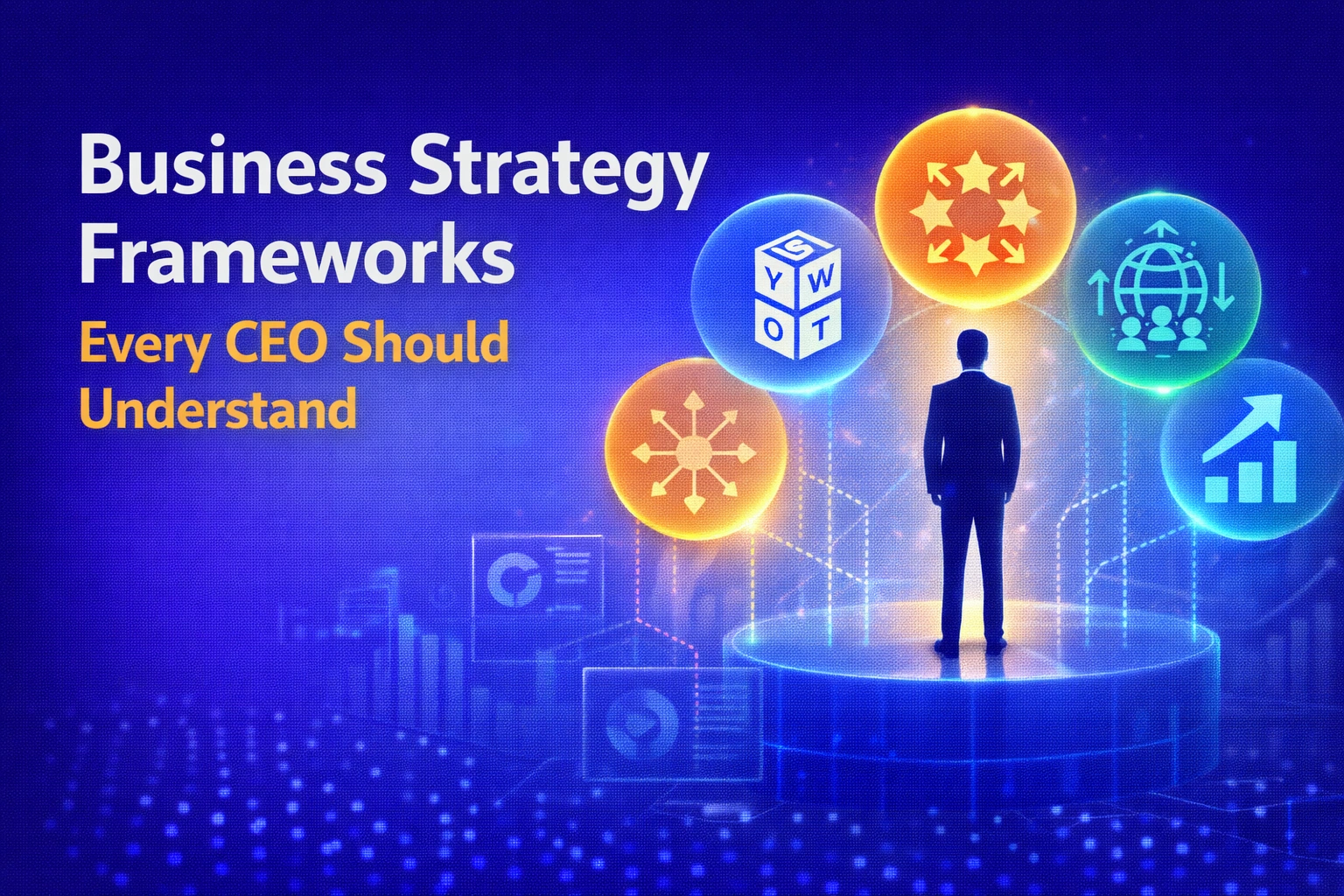
This article explains the most important business strategy frameworks every CEO should understand. Each framework is explained in simple language, with practical relevance for real business situations. No theory overload, no jargon, just clear thinking tools for better leadership.
Why Business Strategy Frameworks Matter for CEOs
CEOs deal with uncertainty every day. Without structure, decision making can become reactive and emotional.
Strategy frameworks matter because they:
- Help organize complex problems
- Encourage long term thinking
- Improve clarity during uncertainty
- Align leadership teams around shared understanding
- Reduce bias in decision making
Frameworks are not strict rules. The best CEOs use them as flexible tools that guide thinking, not limit it.
Understanding the Difference Between Strategy and Planning
Many leaders confuse strategy with planning, but they are not the same.
Strategy is about making choices. It answers questions such as:
- Where should the company compete
- How will it win in those markets
- What activities should be avoided
Planning focuses on execution. It deals with timelines, budgets, and tasks. Strategy frameworks help connect high level choices with practical actions.
Without clear strategy, even the best plans fail.
SWOT Analysis: Seeing the Business Clearly
SWOT Analysis is one of the simplest and most widely used strategy frameworks.
1. What SWOT Stands For
SWOT represents:
- Strengths
- Weaknesses
- Opportunities
- Threats
Strengths and weaknesses are internal factors. Opportunities and threats come from the external environment.
2. How CEOs Use SWOT Analysis
CEOs use SWOT to understand where the company stands today. It helps identify what the business does well, where it struggles, and what external factors could impact growth.
Used correctly, SWOT helps leaders focus attention on the most important strategic issues.
3. Common Mistakes With SWOT
Many companies treat SWOT as a basic exercise with no follow up. The real value comes when insights are turned into decisions.
A good SWOT analysis always leads to action.
Porter’s Five Forces: Understanding Competitive Pressure
Porter’s Five Forces framework helps CEOs analyze the competitive dynamics of an industry.
1. The Five Forces Explained
The five forces include:
- Competition among existing players
- Threat of new entrants
- Threat of substitute products or services
- Bargaining power of customers
- Bargaining power of suppliers
Together, these forces shape industry profitability.
2. Why CEOs Should Use This Framework?
This framework helps CEOs understand why some industries are more profitable than others. It highlights where pressure comes from and how competition affects margins.
It is especially useful when entering new markets or evaluating long term industry attractiveness.
3. Applying Five Forces in Real Life
CEOs use this framework to decide pricing strategies, investment levels, and differentiation approaches. It helps avoid entering markets with poor profit potential.
PESTLE Analysis: Understanding the Bigger Picture
PESTLE Analysis focuses on external factors that influence business performance.
1. What PESTLE Covers
PESTLE includes:
- Political factors
- Economic conditions
- Social trends
- Technological changes
- Legal requirements
- Environmental concerns
These forces shape the business environment over time.
2. Why PESTLE Is Important for CEOs
PESTLE helps CEOs anticipate change rather than react to it. It supports long term planning, risk management, and expansion decisions.
Ignoring these factors can expose businesses to serious risks.
The Ansoff Matrix: Choosing the Right Growth Path
The Ansoff Matrix helps CEOs evaluate growth options in a structured way.
The Four Growth Options Explained
The matrix includes:
- Market penetration
- Market development
- Product development
- Diversification
Each option carries a different level of risk.
How CEOs Use the Ansoff Matrix
This framework helps leaders balance ambition with realism. It allows CEOs to compare growth ideas and choose strategies that align with company capabilities.
It is especially useful during expansion planning.
The Value Chain Framework: Improving Efficiency and Advantage
The Value Chain framework breaks down how a company creates value.
1. Understanding the Value Chain
The value chain includes core activities such as operations and marketing, along with support activities like technology and human resources.
Each activity affects cost and customer value.
2. Why CEOs Should Study the Value Chain?
This framework helps CEOs identify inefficiencies, reduce costs, and strengthen competitive advantage. Even small improvements across the value chain can significantly improve profitability.
Blue Ocean Strategy: Moving Beyond Competition
Blue Ocean Strategy encourages companies to create new market space rather than compete in crowded markets.
1. The Core Idea of Blue Ocean Strategy
Instead of fighting competitors, companies redefine value by eliminating unnecessary features, reducing costs, raising key benefits, and creating new customer value.
2. When CEOs Should Think About Blue Oceans
This framework is useful when industries are saturated and price competition is intense. It helps leaders think creatively and identify new opportunities.
Balanced Scorecard: Turning Strategy Into Execution
The Balanced Scorecard helps translate strategy into action.
1. The Four Perspectives:
The framework focuses on:
- Financial performance
- Customer outcomes
- Internal processes
- Learning and growth
Together, these perspectives ensure balanced execution.
2. Why CEOs Rely on the Balanced Scorecard
It helps leaders track progress, align teams, and ensure that strategy is implemented consistently across the organization.
Core Competency Framework: Playing to Your Strengths
The Core Competency framework focuses on what a company does uniquely well.
1. What Are Core Competencies
Core competencies are capabilities that are hard to copy, valuable to customers, and relevant across markets.
2. How CEOs Use This Framework
CEOs use it to guide investment decisions, innovation priorities, and growth strategies. Staying focused on core strengths improves long term success.
Scenario Planning: Preparing for Uncertainty
Scenario planning helps CEOs prepare for different possible futures.
Why Scenario Planning Matters
Markets are unpredictable. Scenario planning helps leaders explore risks, reduce surprises, and respond faster when conditions change.
Key Business Strategy Frameworks Every CEO Should Know
| Sr. no | Framework | Purpose |
|---|---|---|
| 1. | SWOT Analysis | Understand internal and external position |
| 2. | Porter’s Five Forces | Analyze competitive pressure |
| 3. | PESTLE Analysis | Evaluate macro environment |
| 4. | Ansoff Matrix | Choose growth strategies |
| 5. | Value Chain | Improve efficiency |
| 6. | Blue Ocean Strategy | Create new markets |
| 7. | Balanced Scorecard | Execute strategy |
| 8. | Core Competencies | Focus on strengths |
| 9. | Scenario Planning | Prepare for uncertainty |
How CEOs Should Choose the Right Framework
No single framework fits every situation. Strong CEOs use multiple frameworks together and adapt them to context.
The goal is better insight, not perfect analysis.
Common Mistakes CEOs Make With Strategy Frameworks
Common mistakes include treating frameworks as templates, ignoring real world constraints, overanalyzing, and applying the wrong tool.
Frameworks should support judgment, not replace it.
FAQ’s – (Frequently Asked Questions)
Q1. Are strategy frameworks still relevant today?
Yes. They remain powerful tools for structured thinking.
Q2. Are these frameworks only for large companies?
No. They are valuable for companies of all sizes.
Q3. How often should CEOs use strategy frameworks?
They should be used during planning, reviews, and major decisions.
Q4. Can frameworks limit creativity?
No. They actually encourage clearer and more creative thinking.
Q5. Should CEOs rely on one framework?
No. Using multiple frameworks provides better perspective.
Q6. Do successful companies still use classic frameworks?
Yes. Many global companies rely on them today.
You Might Also Like This:
- How Companies Stay Profitable During Market Slowdowns?
- What are the Growth Strategies Powering India’s Most Successful Companies
Conclusion:
Business strategy frameworks help CEOs think clearly in complex situations. They simplify decision making, reduce uncertainty, and improve alignment.
The most effective leaders do not blindly follow frameworks. They adapt them, combine them with experience, and use them to guide thoughtful action.
In a fast changing business world, strong strategic thinking is a leadership advantage. Strategy frameworks help CEOs develop that advantage with confidence and clarity.









Leave a comment