


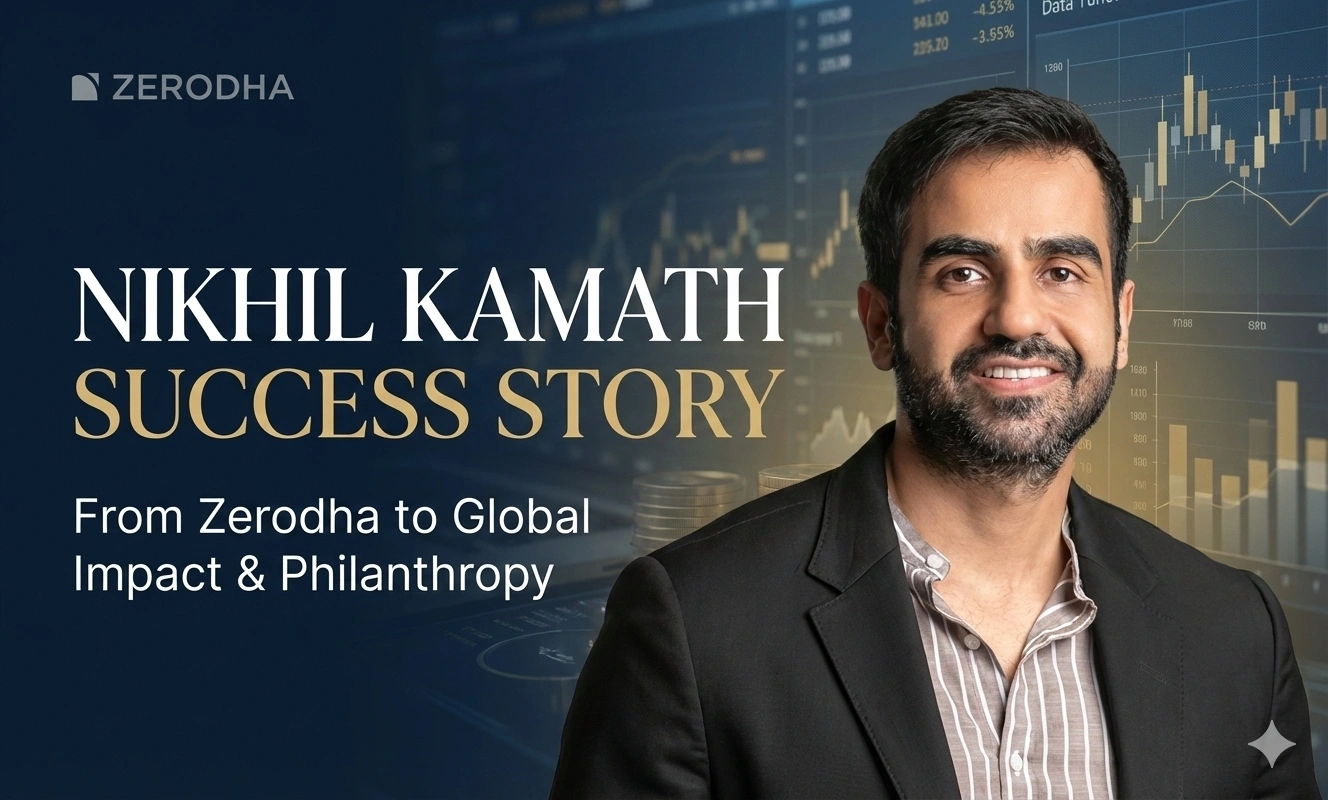
Nikhil Kamath is one of the most influential entrepreneurs in India’s modern financial landscape. As the co-founder of Zerodha and True Beacon, he transformed how Indians invest, trade, learn about finance, and access wealth management services. His story is remarkable because it did not begin in a traditional way.
He did not pursue college, he did not have access to elite educational institutions, and he did not follow the standard corporate ladder. Instead, he learned by doing, built his mindset in the real world, and relied on practical knowledge to build one of India’s most successful financial companies.
His journey from a school dropout to the youngest self-made billionaire in India represents grit, experimentation, and a deep understanding of how technology can simplify complex industries. Before exploring the chapters of his growth, here is a quick overview of the major milestones that shaped his path.
Key Milestones Table: Snapshot of Nikhil Kamath’s Journey
| Year | Milestone | Description |
|---|---|---|
| 1986 | Birth | Born in Shimoga, Karnataka and raised in Bengaluru |
| Early 2000s | Started Working Young | Took up a job at a call center and began trading informally |
| 2006 to 2009 | Built Client Trading Book | Managed portfolios for clients and learned hands on market behavior |
| 2010 | Launched Zerodha | Co-founded the discount brokerage that redefined retail trading in India |
| 2013 to 2016 | Product Innovation Era | Introduced platforms like Kite, Varsity, Rainmatter fintech ecosystem |
| 2019 | Founded True Beacon | Created a wealth management venture for ultra high net worth clients |
| 2020 to 2024 | Recognition and Expansion | Became India’s youngest self-made billionaire and expanded global investment offerings |
Early Life and Background
Nikhil Kamath was born on September 5, 1986, in the town of Shimoga in Karnataka. His family later moved to Bengaluru where he grew up in a modest, middle class environment. His father worked at Canara Bank and his mother managed a small home based business. Despite a simple lifestyle, Nikhil grew up with exposure to financial concepts through his father and entrepreneurial thinking through his mother.
He attended Oxford Senior Secondary School in Bengaluru but was never deeply interested in academics. While many successful founders come from strong academic backgrounds, Nikhil took a different path. He left school after the 10th grade and decided to explore practical work instead of continuing formal education. This choice initially worried his parents but eventually became one of the defining decisions of his life.
Nikhil believes that real world learning, early exposure to responsibility, and the habit of observing people and markets shaped his thinking more than textbooks ever could. This unconventional foundation later helped him build products that everyday traders understood and appreciated.
Early Jobs and First Steps Into Trading
After leaving school, Nikhil began working at a call center at the age of 17. This early experience exposed him to communication skills, disciplined work routines, and customer psychology. However, he was more interested in the stock market. While working nights at the call center, he began trading equities with small amounts of money.
What started as a hobby soon turned into a skill. He observed price movements, learned patterns, understood how news impacted stocks, and slowly built confidence in managing trades. His consistent performance eventually attracted attention from others who wanted him to manage money on their behalf.
By his early twenties, Nikhil was managing portfolios for clients. This was not a formal business yet, but it was the foundation for everything that came later. He learned three important lessons during this phase:
- The importance of risk management
- The need for discipline in trading
- The gap in the Indian market for a simple, low cost brokerage system
These insights eventually evolved into the business idea that became Zerodha.
The Birth of Zerodha: A New Era in Retail Trading
In 2010, Nikhil and his elder brother Nithin launched Zerodha. At the time, stock trading in India was expensive, slow, and dominated by large brokerage firms that charged high commissions. Young traders found it hard to participate because every trade carried a heavy cost.
Zerodha entered with a simple value proposition: Make trading affordable, transparent, and accessible for everyone in India.
What Made Zerodha Disruptive
- Very low brokerage fees that made trading less expensive
- A technology first approach that replaced outdated legacy systems
- A clean, user friendly platform that reduced confusion for beginners
- Strong educational resources that helped users learn without fear
Zerodha became the first major discount broker in India. The timing was perfect because India had started seeing a rise in young investors, growing internet penetration, and increased financial awareness.
The Growth Story
Zerodha grew organically because it offered real value. Without heavy marketing, paid advertising, or celebrity endorsements, the company attracted users through word of mouth. Traders loved the low fees. Beginners loved the simplicity. Long term investors loved the clean, clutter free experience.
Within a few years, Zerodha became the largest stock brokerage in India by active clients. It eventually became a profitable unicorn without outside funding. For an Indian financial startup, this was rare and highly respected.
The Product Culture Behind Zerodha
The company follows a simple philosophy. Build products that are fast, clean, and easy to understand. Make every feature purposeful instead of adding unnecessary complexity. Listen to user feedback, fix issues quickly, and never compromise on transparency.
1. A technology first mindset
Most traditional brokers depended heavily on outdated systems and manual processes. Zerodha did the opposite. It hired talented developers, designers, and product thinkers who understood the importance of speed, reliability, and minimalism. Every platform was designed to reduce friction. Whether it was placing an order, checking charts, or reviewing portfolio data, the aim was to make the experience effortless.
2. Kite: A new standard for trading platforms
Kite became one of the biggest breakthroughs in Zerodha’s journey. It offered a clean interface, smooth charting tools, and a disciplined structure that avoided clutter. Traders from beginners to professionals appreciated the focus on speed and simplicity. By eliminating visual noise, Kite allowed users to concentrate purely on decision making.
3. Varsity: Education as a core value
Zerodha did not stop at creating trading tools. It also launched Varsity, one of India’s most respected free education platforms for financial learning. The content is simple, visual, and organized in a logical flow that helps beginners grow confidently. This commitment to education built trust and helped millions of first time investors feel comfortable entering the market.
4. Coin, Console, and the Zerodha ecosystem
As more Indians started investing in mutual funds and long term equity plans, Zerodha expanded its ecosystem.
• Coin made direct mutual fund investing possible without any commission.
• Console became a powerful dashboard for reports, statements, and portfolio tracking.
These tools gave users complete visibility into their investments, something that earlier brokers did not offer with such clarity.
5. Rainmatter and the focus on fintech innovation
The product culture at Zerodha also encouraged collaboration. Through Rainmatter, the company invested in and supported young startups working in finance and technology. This created an ecosystem of new ideas, new tools, and new solutions that benefited the entire financial community.
6. A culture rooted in listening
Zerodha’s team constantly observes user behavior, reads community feedback, and releases updates quietly but consistently. This habit of listening to users has played a major role in its success. The company does not chase trends. It focuses on building stable, thoughtful, long lasting products that truly empower investors.
Transition Into Asset Management: The Birth of True Beacon
After Zerodha’s massive success, Nikhil moved into the wealth management space by co-founding True Beacon in 2019. While Zerodha focused on the mass retail audience, True Beacon targeted high net worth and ultra high net worth individuals.
The goal was simple:
Create an investment platform built on transparency, fairness, and global wealth preservation.
What True Beacon Offers
- Category III Alternative Investment Funds
- Global investment access through GIFT City
- A performance fee only model that aligns with client interests
- Strategies built on risk management and capital preservation
True Beacon quickly gained traction among India’s wealthy investors due to its modern approach and founder credibility.
Investment Philosophy of Nikhil Kamath
Nikhil’s investing style is a mix of practicality, data driven decisions, and behavioral understanding. He often speaks about the importance of:
• Avoiding emotional decisions
• Maintaining small position sizes
• Surviving bad market phases
• Focusing on long term consistency
• Understanding human behavior more than complex formulas
His approach stands out because it is shaped by real experience rather than purely theoretical frameworks.
Public Influence, Podcasts, and Thought Leadership
In recent years Nikhil has become a significant voice in India’s business and finance community. Through podcasts, interviews, and his series “WTF”, he has engaged with global thinkers, entrepreneurs, artists, and policy influencers.
His content appeals to younger audiences because it discusses success, money, mental health, talent, and societal pressures with refreshing openness.
He also participates in philanthropic initiatives and social programs, often encouraging young Indians to think independently and question outdated norms.
Challenges, Criticism, and Controversies
With success comes public scrutiny. Nikhil has faced criticism at times for his comments, his unconventional views on education, and high profile online debates. Zerodha, being a large brokerage, has also faced industry level regulatory attention.
However, Nikhil views criticism as an inevitable part of leadership. He openly addresses mistakes and continues to focus on building long term value for users and clients.
Lessons Entrepreneurs Can Learn From His Journey
- You do not need traditional education to succeed if you are willing to learn continuously.
- Understanding customer needs deeply can give you a strong competitive advantage.
- Technology can simplify even the most complex industries.
- Discipline and risk management are essential in both life and business.
- Building without external funding is possible with clear focus and value delivery.
FAQ’s – (Frequently Asked Questions)
Q1. What is Nikhil Kamath best known for?
He is best known as the co-founder of Zerodha, India’s largest retail brokerage, and True Beacon, a wealth management firm.
Q2. Did Nikhil Kamath complete his college education?
No, he left school after the 10th grade and entered the workforce early.
Q3. How did Zerodha become successful?
By offering low brokerage fees, a seamless technology platform, transparent pricing, and powerful educational tools that helped beginners learn easily.
Q4. What is True Beacon?
True Beacon is an investment management company focused on high net worth clients and global wealth preservation strategies.
Q5. Why is Nikhil Kamath considered unique?
Because he built billion dollar businesses without formal education, without external funding, and purely through practical learning and customer understanding.
Q6. What can young entrepreneurs learn from him?
They can learn the value of consistency, humility, real world learning, and solving real customer problems instead of chasing trends.
You Might Also Like This:
- Read The Incredible Journey: Nitin Kamath Success Story
- How Magazines Help Build Your Brand and Network
Conclusion:
Nikhil Kamath’s success story is a modern Indian inspiration. His journey shows that talent is not limited by degrees, backgrounds, or traditional expectations. From a teenager working in a call center to building India’s most trusted brokerage and becoming the country’s youngest self-made billionaire, his story captures the spirit of innovation, courage, and continuous learning.
For today’s entrepreneurs, investors, and dreamers, his life offers a powerful reminder that meaningful success comes from taking risks, learning constantly, understanding customers deeply, and staying true to your vision even when the world doubts you.





Leave a comment